Tuesday, June 10, 2014

The Hippest Post you Know! New Hippasteria species!

Research! People often speak of the rigors, hardships and even agony of their research. The long days in the field to the writing and so forth.. But what a lot of folks don't often spotlight is how damn satisfying it is (at least for me) to see something you've been doing for several YEARS come to fruition in a paper! 

Case in point is my newest starfish monograph, just published a week ago in the prestigious Zoological Journal of the Linnean Society!  You can go here to find it (sorry-paywall).

This was part of a project that began years ago in 2011 or so, as I discovered several of the specimens described below in the collections at the Muséum National d'Histoire Naturelle during one of my visits to study their starfish from far and distant lands! 

This, then combined with a project I was working on with my colleague Dave Foltz at Louisiana State University and eventually snowballed, adding on Marc Eleaume, my colleague from Paris and Kate Neill from the New Zealand Institute of Water and Atmospheric Research (NIWA). 

What's it all about?? 
You may remember a post I wrote last year about some work I did with my colleagues where we discovered that the starfish species Hippasteria phrygiana was not simply one species in the Atlantic but in fact one species that was found across THREE OCEANS! (here to see the full story)

Part of this work involved not only Hippasteria phrygiana, but testing whether or not the OTHER species of Hippasteria were the same! And what about other potentially new species?? Were those new?? 

My colleagues, especially Dave Foltz analyzed tissues sampled from samples of multiple Hippasteria species taken from all around the world. From the Atlantic to the North Pacific to New Zealand (South Pacific) to Kerguelen Island in the southern Indian Ocean! 

We sampled for genes and compared them using analysis software to get this tree, which showed us which were the mostly strongly supported species..
We ended up with 7 species, 3 of them were new to science!  Of the other 4, H. phrygiana we kinda changed (see below) and here. Hippasteria californica had some weird dynamics (see below, Hippasteria heathi was a "good" species but we found out that it had cousins which were found WAY beyond where  it was found and the final species Hippasteria lepidonotus turned out to have been "oversplit" into the genus Cryptopeltaster. That is, it turns out to be a redundant name which was likely created because of the deceptive amount of differing morphology in that species (and thus thought to be more different than it actually was).  

So, let's see some new species!!  Many Hippasteria related species are predators of deep-sea coral predators and I've described other new starfish species related to these, which you can read about here.  

1. Hippasteria muscipula
This one is the biggest and neatest of the new species I described.. A big, massive critter about 30 cm (about a foot across)! 

It was collected from various tropical Pacific localities: Hawaiian Islands, New Zealand south of New Caledonia in deep-water. 425 to 1500 meters!

What's cool about it?? The name.  The species has these very big and toothy pedicellariae (aka claw like structures on the surface, possibly used for defense)
The species was Hippasteria muscipula after the pedicellariae's resemblance to the Venus fly trap (Dionaea muscipula)!
One other cool thing we found? The specimen from New Caledonia had its stomach wrapped around a deep-sea "coral" called Metallogorgia, which is kind of an odd looking gorgonian that looks like a living wire hanger! Possibly feeding on it??  Interesting. 

2. Hippasteria tiburoni
This new species was a little tiny thing collected by the Monterey Bay Aquarium Research Institute from Pioneer Seamount in the North Pacific (southwest of San Francisco) in 2005
This species was distantly related to Hippasteria heathi, which occurs primarily in the Aleutians..
This species was named for its "collector" the now defunct Remotely Operated Vehicle Tiburon which served science and MBARI well between 1996 and 2008!
Hippasteria tiburoni, despite its size was observed feeding on deep-sea bamboo coral!!  Ain't it an awesome little critter?? 

3. Hippasteria mcknighti
The third new species we described was found among specimens sent to us from the New Zealand Institute of Water and Atmospheric Research.  It resembles the North Pacific Hippasteria heathi but the genetic and morphological data support it as being distinct..

4. Big Taxonomic Changes! 
The rest of the paper addresses multiple taxonomic changes (i.e. names of species).  Among the most significant of these was the big discovery of how wide-ranging a species, Hippasteria phrygiana turned out to be!!   This was a species found in THREE OCEANS! 

The problem with this discovery was that historically, folks would often describe a new species if it was not previously known from that part of the world and sometimes there are widely occurring animals which do form regional subspecies. It depends.
                    
But in this case, thanks to our genetic data, we could tell that a great many described species, which were likely separated as distinct species based on minor differences are in fact, just minor variation of one wide-ranging species!

In this case nearly a dozen species, were found to be "redundant" or were applied to Hippasteria phrygiana throughout different parts of the world. 

We also looked at the other species of Hippasteria, H. californica which occurs in deeper water habitats than H. spinosa... 
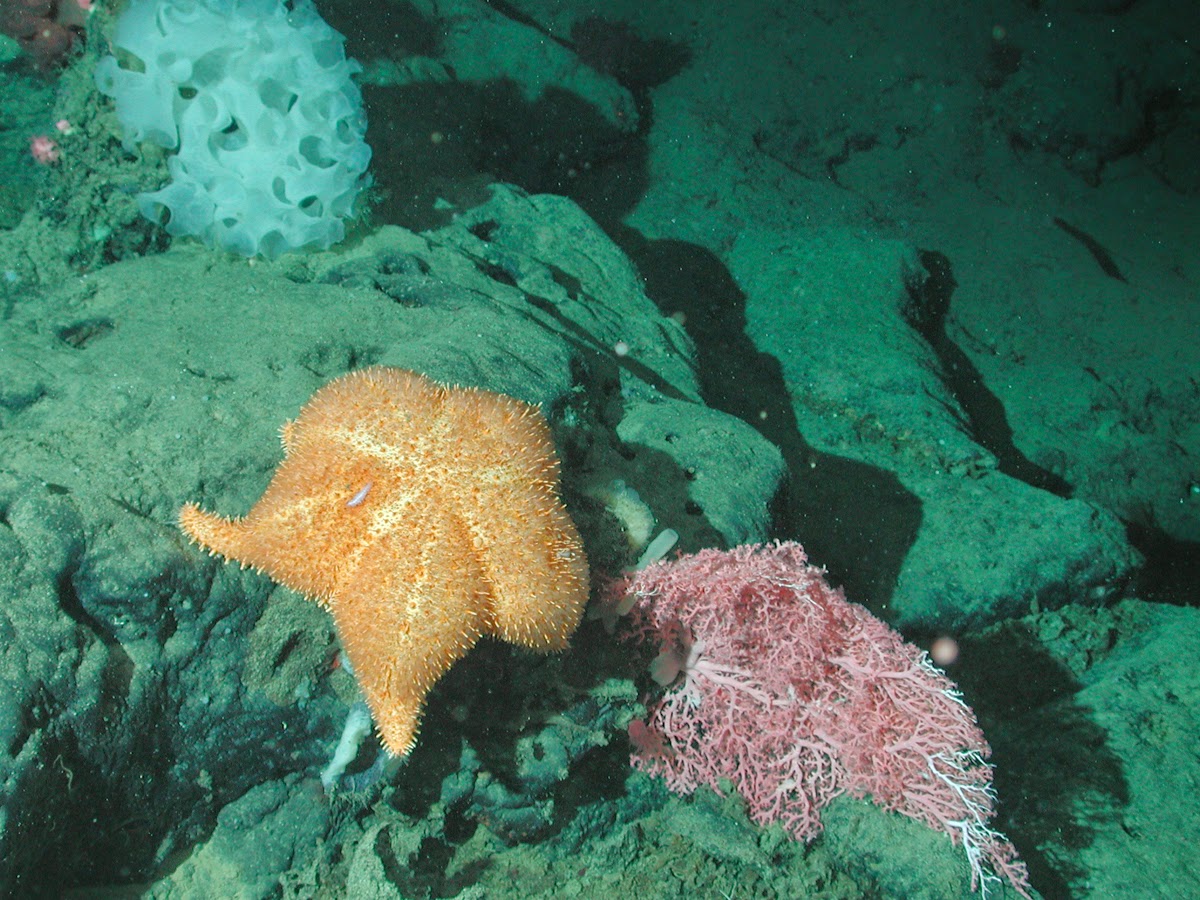
Image by Dr. Steve Lonhart Via SIMON
What we had found, up this point had been pretty consistent with what had been known until we found two individuals of this species which were revealed by genetics to have been Hippasteria californica BUT in SHALLOW WATER habitats in British Columbia AND which looked like H. spinosa!

Weird.
Image by Neil McDaniel (check out his website here)
STRANGE! And a mystery that we shall have to investigate for another day....

OTHER Related Posts:
New genera and species of Hippasteria related starfish species! 

Deep-sea Corallivore Video from MBARI!

Tuesday, June 3, 2014

P is for Parasitic Snail! Enter: The Eulimidae!
From the Eulimidae EOL image gallery-Moorea Biocode
Last week, we saw some pics of big predatory snails feeding on starfish!  This week, we turn our attention to smaller snails with a more insidious means of feasting on their hapless echino-prey!

Behold the Eulimidae! A family of snails, whose primary means of nutrition is feeding on echinoderms...specifically as PARASITES! They pretty much attach themselves to every class within the living Echinodermata: urchins, crinoids, brittle stars, sea cucumbers (remember the sea pigs?) and today's subject... starfish!!

Eulimids are insanely diverse. There's over 85 genera and easily hundreds of species. With likely more being discovered as they are found on their hosts..

If you guys ever need a one-stop shop paper on the Eulimidae, you are in luck! This paper (behind a paywall) includes a summary of biology as well as an overview to all the genera.   The acknowledged world expert on these is Anders Waren,  a scientist at the Swedish Natural History Museum

Basically, eulimid snails feed by sticking their proboscis into their host and sucking the tasty, delicious juices out of them. This in itself is kind of interesting because most echinoderms use a kind of specially treated seawater (filled with body cells called coelomocytes) as a bodily fluid.

Apparently, its these cells-the coelomocytes upon which the snails feed... Note below, the extended probsocis...

This snail was described as Melanella with what appears to be its proboscis extended and gives you a general idea of how these snails operate...
Image from EOL's Eulimidae image gallery
Here is a snail in the genus Parvioris with its proboscis extended and the animal hard at work..
From the Eulimidae EOL image gallery-Moorea Biocode
From what I've been able to determine, certain snails DO tend to occur on certain hosts, but the pattern doesn't always seem to be consistent. Some specific species of snails apparently occur on different starfish hosts but some are specific to types of hosts, e.g. sea urchins or sea cucumbers.. Many of these are undersampled, and so it still remains to be seen how much host variation is observed..

1. Ectoparasites. Some eulimids are ectoparasites, that is they are attached, but only on the exterior.. Here's one hunkered down on the disk of the very gorgeous goniasterid Iconaster longimanus.


Here's another one attached to the sand star Archaster from Singapore, but several species of starfish are often hosts. Here's a short write up on their page about them..


Another well-known ectoparasite is the eulimid called Thyca crystallina...

These are famously parasites on the blue starfish Linckia laevigata where they are often found on the oral surface around the tube foot grooves..

We often see these snails well-camoflaged as the same distinctive color which identifies their host...

Some are not so well-hidden.. (and yes, sometimes Linckia laevigata is orange!)


2. Endoparasites!  On the OTHER hand..some eulimid snails, get pretty "dug in" and have literally buried themselves in their work!

They basically embed themselves in the host, attach their proboscis directly to the internal arm canals and just suck on em' all day....  This one, Parvioris fulvescens looks like its embedded itself in what looks like Ophidiaster (?)
From Femoreale Shells via EOL
Here..we have some which have embedded themselves in Neoferdina, a goniasterid... Note how they've pretty much buried themselves INTO the skeleton of the animal. The starfish are strongly calcified.. and since there's no clear damage, I wonder if  these get in as juveniles...

Here's one called Stylifer which has buried itself in the arm of the ophidiasterid Linckia multifora


3. Parasites of the Deep! 
and lest, you think that eulimids only parasitize shallow water reef species, let it be known that many deep-sea starfish are also parasitized by snails! Here is Asterophila japonicus as reported by Sasaki et al. in: Sasaki, T., Muro, K. & Komatsu, M. 2007. Anatomy and ecology of the shell-less endoparasitic gastropod, Asterophila japonica Randall and Heath, 1912 (Mollusca: Eulimidae).Zoological Science 24(7): 700-713.

This species seems to be a host in the astropectinid sea star Leptychaster,where it has burrowed UNDER the disk and lives right above the stomach!
Several of the deep-sea snail parasites are VERY unusual and some have bodies which are SO reduced that you can barely recognize them as snails..  One deep-sea snail parasite, Asterophila rathbunasteri described only in 1994! lives as a gall in the arms of the deep-sea, multi-armed asteroid which lives off the west coast of North America...
Which they were actually unable to ID to phylum until they realized, when it was spawning, that it was producing veligers (snail juveniles)!!

the HORROR!

Tuesday, May 27, 2014

Snails that eat Starfish! Predation in the tropical Indo-Pacific!


In cold and temperate water habitats, starfish, especially asteriid starfish are often predatory. ESPECIALLY on mollusks! Famously on bivalves and clams but also quite a few gastropods aka snails.
But in the tropics, we often find the tables are turned! Snails, especialy giant snails, such as these Giant Tritons (Charonia sp.) are big, ol' meanie predators on several often, equally large and heavily armored (or at least well-defended) starfish species...


The Triton Vs. Crown of Thorns (Acanthaster planci) 
Just walked out of Godzilla and want to see two big monsters fight it out?? You've come to the right place!

The "Triton's Trumpet" is a large snail with a shell that is often up to two feet long. Because it is large and showy, it is often sought after as a souvenir.   Here we have not one but TWO videos of these giant snails attacking the very spiny Crown of Thorns starfish, a voraceous predator of corals


When the snails get to work, they often appear to be successful. But even if not, with the crown-of-thorns starfish there's *literally* many more fish (or starfish) in the sea!

this did not end well for the starfish.


The Triton vs. the "Blue Linckia" aka Linckia laevigata
Here..what you are seeing is NOT a hermit crab, but one of these giant triton snails finishing off its dinner, a blue Linckia laevigata, eating it disk first with the legs sticking out of the shell's opening..


Here's what this looks like with a bit more perspective...

The Triton vs. the Cushion Star (Culcita novaeguineae)
Another target species?  The big, round, almost pillow shaped starfish Culcita novaeguineae!

A pic to give you some perspective...


Other Indo-Pacific species include Choriaster granulatus 

Nardoa novaecaledoniae (Ophidiasteridae)


And in the Atlantic Caribbean (Cozumel), this "triton" snail attacking the tropical Oreaster reticulatus.  Honestly, I'm not sure if I've ever heard of this.. maybe something new? Will have to check...

Attacking a small specimen of Oreaster.. maybe O. clavatus?
via Wikipedia from NOAA photo library
And of course, its not always, the BIG snails.. the tiny ones can be predatory as well.. Here are individuals of Phos nodicostatum (Buccinidae) feeding on the arm of a crown of thorns..


NEXT UP! Pt. 2 to this.. SNAIL PARASITES!! 

Tuesday, May 20, 2014

Brittle Stars are EVERYWHERE: 5 EXTREME Ophiuroid Habitats!

fringehead1Jan19-14
Brittle stars are EVERYWHERE. They are not only the most diverse (over 2000 species), but also the most ABUNDANT of echinoderms (go here for the full thing)

The truth is that they live frakkin' EVERYWHERE. The diversification of brittle stars is thought to have been successful mainly because they've found a niche just about anywhere and everywhere they can! They live in all the nooks and crannies on the marine bottoms: buried in sediment, rocks, sponges, corals so on and so forth..
Tiny in-a-sponge brittle stars (Ophiactis savignyi) in chocolate sponge (Spheciospongia cf. vagabunda)

Some Brittle stars live in some of the deepest places on earth down to >8,000 meter depths! (here)

But brittle stars also manage to find some pretty crazy, unusual and just downright SURPRISING places to live. Are there ANY habitats which which they cannot exploit???

Here's a few of them....

Ophiuroids GO where other Echinoderms fear to tread! 

1.  Floating Plastic Garbage.
garbage-patch-19-hoshaw_lindsey
A recent paper by my colleague Miriam Goldstein et al. (2014) in Marine Biology has documented ophiuroids among the plastic garbage debris "islands" found in the North Pacific.  In this case, I'm told, there were hundreds among some of the ropes on these bundles... (my thanks to Miriam and her co-authors for the paper & sharing their info!)

Although garbage/debris is created by humans, it may functionally serve as just another venue for brittle stars to practice rafting, which is one means for animals that don't swim as adults, to be dispersed widely via ocean currents. 

I've also written about the tiny, 6-rayed brittle star, Ophiactis which has likely been transported all around the world via human activity, probably like this and several other ways.....

2.  Jellyfish.
Speaking of one of those other ways?? I wrote about brittle stars "rafting via jellyfish" in one of my posts from 2009! (here)  But the short version is that some species are regularly found inside jellyfish for uh..... various possible reasons (go see the post to see the discussion why..)

another great pic of this can be found over here! 
via Thomas Peschak Photography
3. Hydrothermal Vents.
Here is ANOTHER place you generally don't expect to find echinoderms. Why? Because most of the environment around hydrothermal vents is not just, very, VERY hot but also filled with toxic chemicals, such as hydrogen sulfide.
East Pacific Vent from this R. Blake's page
Given how sensitive most echinoderms are to having clean, seawater these factors probably exclude most other echinos from being present in these poisonous areas. and YET somehow brittle stars have found a living here.

Observe Ophiolamina eprae from the East Pacific Rise. And there are actually about three others that live in and around vent settings...

This species actually looks like it lives directly in the path of some of the hot water and toxic materials...
From IFREMER
4. Brackish Water (i.e., nearly fresh water)
Image via Florida shellfish ID guide
Echinoderms are exclusively marine and they don't handle shifts in the amount of salinity in the water well. Some echinoderms, such as sea stars will often die from a significant drop in ocean salinity from say, a big rainstorm.

Salinity in ocean water ranges  about 30-50 ‰  (ppt)  and freshwater is generally less than 0.5 ‰ (ppt). A lot of sea stars, for example start to get unhappy when you drop below 30ish ‰ (ppt). 

But some brittle stars? Brittle stars are probably the toughest of the echinoderms with some species, such as the above Ophiophragmus filograneus (Amphiuridae) can withstand up to 7.7 ‰ (or ppt-parts per thousand). 

Another species in the Amphiuridae, Amphipholis squamata has been recorded as withstanding salinity as low as 5 ‰ !!
from Wikipedia! 
In the salinity battle, brittle stars are tough, little bastards.

5. Crinoids! 
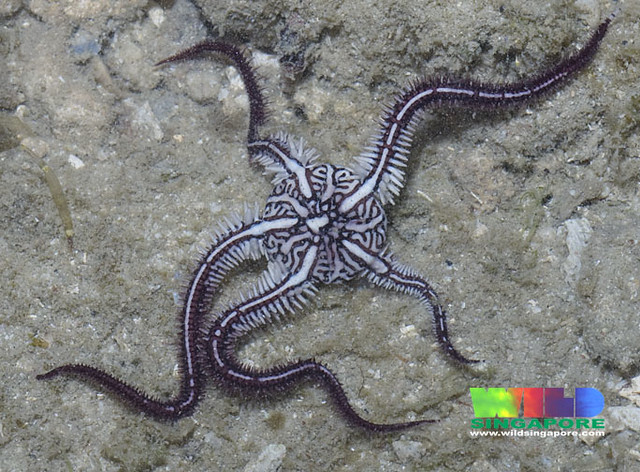
Here's one species, Ophiomaza chaotica a strikingly black and white species which famously lives on feather stars! A short write up on it at Wild Singapore here. 
Pale feather star (Class Crinoidea)  with Feather-hitching brittle star (Ophiomaza cacaotica)
Blue feather star (Class Crinoidea) with Feather-hitching brittle star (Ophiomaza cacaotica)
Feather-hitching brittle star (Ophiomaza cacaotica)

BONUS!
and I found this pic of a tiny striped brittle star living on Ophiomastix annulosa  Another example of commensalism?? Maybe one just incidentally crawling on the other? It wasn't actually clear and unfortunatley I couldn't actually find a record Ophiomastix-on-Ophiomastix action..so for now a mystery...
Ophiomastix varabilis brittle star ind11a 1086

There ARE some accounts of brittle stars living symbiotically on other brittle stars but for various reasons, those are the subject of a future post!

UPDATE:  Should also have mentioned that brittle stars live on that other extreme deep-sea habitat-WOOD. But that's a story for another day...
Borrowed from my friends at Deep-sea News

Tuesday, May 13, 2014

New Paper! New Species! How the Blog Informed my Research!

When I started writing this blog back in 2008, one of the biggest questions I had was whether or not the blog would have ANY sort of impact on my primary studies in starfish diversity and evolution. 

 How could something that I thought would essentially be only an educational platform benefit my research??? 

Well, with a recent publication by myself and colleague Dave Foltz at Louisiana State University, which was just published in the journal Zootaxa, you can see how! 

So, the paper's primary focus was on the family Poraniidae, which is a small but unusual group of cold-water starfishes which have kind this weird fleshy covering over their skeleton. 

The surface of these animal is soft to the touch and they look sort of velvety like so.... (Porania pulvillus is shown).

Truthfully, no one has known much about them and as such, it was unclear what kind of relevance they had to the bigger scheme of biology.

A few years ago, starfish paleontologist Dan Blake described Noriaster barberoi from the Triassic of Italy. Triassic starfish fossils are incredibly rare and potentially provide insight into the early evolution and history of all starfishes. 

Dr. Blake identified these fossil starfish as members of the Poraniidae, making them potentially important in the "big tree" of starfish evolution.  
photo by Dan Blake, via the ATOL website.
Later, my work with Dave Foltz from 2011 showing the "family history" of one major group of starfishes, based on evidence from DNA suggested that their position in the big "family tree" might indeed be important to understanding the early evolution of all starfishes.

But we understood very little about the ecology and life modes of LIVING members of this group.

But usually, one of the first steps towards understanding these "family trees"  is to "straighten out" the many different kinds of genera and species in the Poraniidae. (or any discrete group of starfishes).

There's a LOT of stuff in a paper like this..so here are some highlights... 

There's an overview of known genera and species
Chondraster grandis? from the North Atlantic. We know almost nothing about this species..
Here is Poraniopsis inflata, which occurs along the Pacific coast from Japan to Alaska and south along the west coast of North America to California. A related species occurs widely in the Southern Hemisphere. 
Some new genera and species...
One of the delights in looking through big museum collections and specimens from an endless number of research expeditions is the possibility of finding a new species or even a new genus! 

In the bigger, evolutionary sense, this would be like finding a long lost member of your family you never knew about. Then, you need to figure out how/where/who it is...

Among the neat new species found? 

First was this weird thing from deep-sea habitats (roughly 1600 meters!) south of Macquarie Island on Hjort Seamount. This specimen was "hidden" among the collection of the US Antarctic Research Program and collected in 1965!! (you may recall I wrote of this collection awhile back)  I've found other new species from the US Antarctic Research Program... its the gift that keeps on giving! 

First..may I present the new genus and species:  Clavaporania fitchorum!
                                              
The new genus is named "Clava" or club shaped which refers to the spine and "Porania" which is the name from which the family Poraniidae derives its name.  The species is named for Mason & Lisa Fitch, who are ardent supporters of my research! 

The OTHER new, cool species we found was a tiny little (it was about 1.5 inches across) animal collected by the Monterey Bay Aquarium Research Institute (MBARI) from Davidson Seamount in the North Pacific from an astonishing 2669 meters!  I have much thanks to benthic ecologist Jim Barry and biologist Lonny Lundsten for their help in making the animal available to me. 
with new species, come NEW observations!  MBARI was working on/collecting this deep-sea "black coral" aka an antipatharian..

The new species (note the white arrow) was found among the other echinoderms present on the branches
                         
My take on the pictures was that this starfish was feeding on the fronds since to my eye, some of those fronds are gone..So, PREDATION??? 

I couldn't help notice that the animal had actually crawled UP into the branches. And from that I gave the animal its species name- Bathyporania ascendens.  The genus was Bathyporania  which comes from "Bathy" for depth and "Porania" which again is a the primary name for taxa in the Poraniidae. species is called "ascendens" for "ascent" or to climb because of the fact that it climbed up into the branches of this black coral...

This ecological observation nicely dovetailed with BLOG STUFF! Ahoy the Internet! I wrote this post in 2013 (last year) about what I thought might be a bunch of neat observations on feeding in poraniids based on observations present on the Internet...  such as Porania pulvillus shown here feeding on a sea pen.
From this EOL page via SERPENT
And the case I made there was simply this: Poraniids had always been thought of as fairly passive feeders. What if they AREN'T?? Maybe they feed more aggressively as predators?? 

And this line of thinking from the blog eventually made its way into a nice part of the paper discussion!  which for me, leads to a nice paradigm shift about this poorly known group of animals! 

The internet observations had colored and further fleshed out my published work! Who knows how it will be corrupted by blogging next? Woo!

Tuesday, May 6, 2014

Stalked Crinoid Round-Up!


CRINOIDS!  These are considered the oldest of all the living echinoderm groups. Fossils of crinoids are commonplace in the Paleozoic (see examples here). 

Most modern crinoids go by the name "feather stars" (for example here) because their adult forms no longer retain the long stalk present in these older forms. This heritage, however, IS retained in feather stars, which have a stalk when they are juveniles (see this post). 

Crinoid feeding biology is fundamentally a simple matter. Arms are outstretched into the water current and food is caught by the branching on the arms and moved to the mouth present in the cup (also called the calyx which is a damn good Scrabble word).

Of the approximately 600 species of crinoids alive today, about 95 of them are stalked but belong to a diversity of different genera, family and species. Nearly all of these live in the deep-sea where they occur at great depth, ranging down to the deepest known depths (9000 meters!)

NEW species of stalked crinoids continue to be discovered!! Such as this Antarctic species described by my French colleagues at the Museum national d'Histoire naturelle in Paris.

One of the primary differences in overall morphology is how and whether they are attached.. As you can see, the yellow Hyocrinus  (family Hyocrinidae) on the left side is permanently anchored to the rock, whereas the Endoxocrinus (Isocrinidae) on the right side has a stalk that ends as kind of a tail, which allows it to crawl around and move. (presumably to escape predators as outlined here).


Feather Stars (i.e., unstalked crinoids) occur mostly in shallow water and can actually swim if threatened.. (see here). 

Today, I just thought it would be cool to share the diversity of stalked crinoids that are around TODAY.   Life modes of fossil species can be pretty amazing as outlined here.

We start with an unusual stalked crinoid.. Neogymnocrinus richeri in the Sclerocrinidae...

These have a short stalk with these thick, unusual arms and a palm-like cup. Its possible these feed a little more aggressively than their other filter-feeding cousins... 


Endoxocrinus? (I think) from the tropical Atlantic


An interesting stalked crinoid I don't recognize with distinct segments on the stalk..  from Indonesia)

Another interesting one with only 5 arms..(from Vailu'lu Seamount in the central tropical Pacific). Dr. Marc Eleaume at the Paris museum thinks this might be Guillecrinus neocaledonicus

The distinct yellow stalked crinoid Hyocrinus  from the North Pacific


A red stalked crinoid species from Indonesia. Probably Proisocrinus ruberrimus according to Marc Eleaume at the Paris museum.

Close up


Another interesting red stalked crinoid from Indonesia. Note the weird fuzz on the stalk? Possibly hydroids or some other kind of animal.... 

Some of you may remember that we saw a stalked crinoid in the North Atlantic via the Okeanos dive last year which ALSO had these interesting growths on the stalk... 
                            
                                  
Here's one of the deepest occurring kinds of stalked crinoids, a bathycrinid which seems to be anchored in sediment..
image from SERPENT archive
Like their shallow water counterparts, its not unusual to find several stalked crinoids in the same place, taking advantage of a good water current for feeding... which makes for an almost surreal deep-sea bottom...